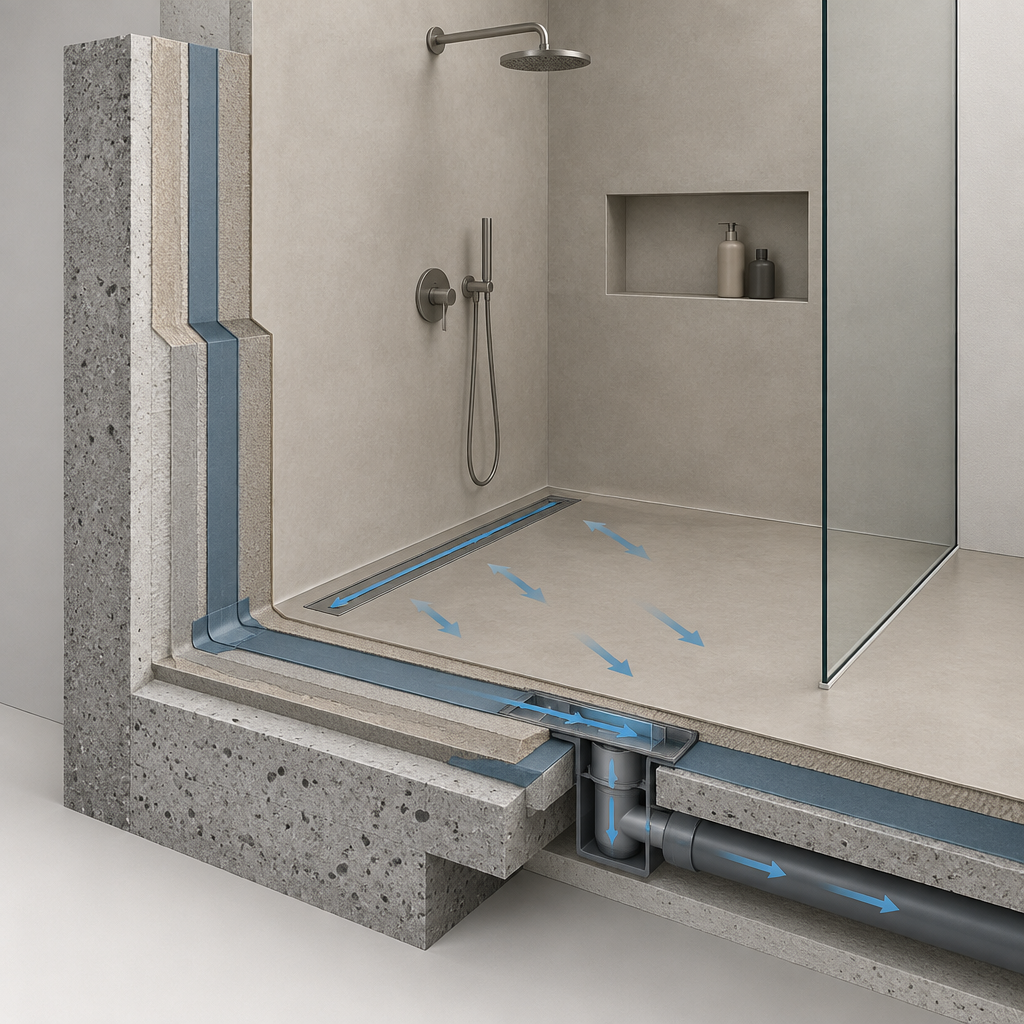
Can microcement in the bathroom be used in a shower, and how should it be maintained? Yes, provided the chosen system is intended for the specific wet area, the substrate is properly prepared and sealing is addressed. The microcement name, a matt appearance or a protective lacquer layer alone does not confirm this.
Before commissioning work, it is worth clarifying three things: what protects the structure from water in the chosen system, when the surface can be put into use and which products can be used to clean it. This guide will help you ask specific questions, but does not replace the manufacturer’s technical instructions or project-specific solutions.
Does microcement in the bathroom replace waterproofing?
There is no universal answer. Microcement must be assessed as a complete system of compatible materials, not just a decorative top layer. The need for separate waterproofing, the layer composition and joint sealing are determined by the chosen system’s documentation and site conditions.
For example, in the FESTFLOOR product catalogue the HydroFest system described has its own solution for wet-area installation, which includes sealing tapes at joints and around the drain. This solution cannot automatically be applied to another manufacturer’s microcement.
A protective lacquer is not, in itself, proof that the entire structure is watertight. The Topsealer Pro Fast technical data sheet distinguishes resistance to running water from continuous contact with water. A product suitable for shower finishes is therefore not necessarily suitable for a container permanently filled with water.
Different bathroom areas – different questions
| Area | What must be assessed | What is not enough |
|---|---|---|
| Shower walls | The system’s suitability for direct exposure to water, and sealing of corners and penetrations. | A general claim that it is “moisture-resistant”. |
| Shower floor | Watertightness, substrate stability, slope, drain connection and the final surface’s suitability for wet floors. | An attractive sample or a matt surface alone. |
| Washbasin area | Resistance to splashes, cosmetic residues and the intended cleaning products. | The assumption that all household cleaners are suitable. |
| A container permanently filled with water | Separate confirmation that the system is suitable for this use. | A recommendation for use in showers. |
A seamless surface does not mean there are no joints
The description “seamless” generally refers to a continuous decorative appearance and the absence of tile grout joints. However, wall-to-floor junctions, corners, the drain, pipe penetrations and structural movement joints remain important.
Before work begins, ask for an explanation of how the chosen system addresses each of these locations. A technical joint cannot be eliminated simply because a seamless finish is desired. It is also important for water to flow into the drain rather than collect on the surface: a decorative coating should not be treated as a correction for an inadequate slope.
When should you consult a designer?
A designer’s assessment is required when the shower location, drain position, floor structure or floor height is changed and the solution affects the floor slab, water drainage or adjoining rooms. Cracks, recurring dampness or previous leaks are also reasons to establish the source of the problem first, rather than cover it with a new finish.
If structural movement or damage to the load-bearing substrate is suspected, a structural engineer’s assessment may be needed. The choice of finish does not replace a structural solution.
What should be checked in a bathroom being renovated?
A stable surface of old tiles does not prove that the waterproofing beneath it is adequate. These are two separate checks: whether the substrate is suitable for the new coating and whether the existing structure is reliably protected from water.
If it is not known how the old shower was installed, there have been leaks or there are visible signs of dampness, simply coating over the tiles is not an adequate solution. Further inspection or exposing part of the structure may be necessary. This risk is worth discussing before approving the estimate.
When can the shower be used after the work?
Completion of the work, surface drying and full curing are not the same thing. The timing depends on the specific products, their layers and environmental conditions. One system’s time before use cannot be applied to another.
Topciment’s maintenance recommendations emphasise additional precautions during the first weeks, until the coating reaches its maximum hardness and chemical resistance. This does not mean there is a uniform waiting period for all microcement products.
Ask for three stages of use to be distinguished in writing:
- Walking: when it is permissible to step onto the floor and which loads should still be avoided.
- Contact with water: when the shower can be used.
- Cleaning: when cleaning products can be used and which ones.
If these times are unclear, they should not be determined by whether the surface already looks dry.
Daily maintenance and limescale removal
The maintenance instructions must be specific to the installed system. Mild products and a soft cloth or sponge are often recommended for daily cleaning, but their suitability must be checked against the manufacturer’s instructions.
- Remove soap and cosmetic residues using a product approved by the manufacturer.
- Use the cleaner at the dosage specified in the instructions and leave it on the surface only for the stated time.
- If the instructions require it, rinse off cleaner residues and dry the surface.
- Ensure the bathroom is ventilated; the finish alone does not resolve moisture problems in the room.
Limescale remover is not a universally safe choice. Do not use vinegar, citric acid, strong acidic or alkaline products without explicit approval from the system manufacturer. The same applies to abrasive powders, rough sponges and steam cleaning.
Before using a product you have, check not only its name but also its concentration and permitted contact time. A test in an inconspicuous area may reveal a visible reaction, but does not replace the manufacturer’s approval.
Frequently asked questions
Is matt microcement less slippery?
A matt finish alone does not confirm this. Ask about the specific final system’s suitability for wet floors and its slip assessment. The surface must be assessed with the intended protective layer, not just the decorative texture.
What should you do if you notice a scratch, darkening or a crack?
Photograph the damage and contact the contractor who carried out the work. Do not sand or re-lacquer an unknown system yourself. If a crack or darkening may be related to water entering the structure, limit water exposure in that area until it has been assessed.
Will the protective layer need to be renewed?
This depends on the system, intensity of use and condition. There is no universal renewal interval. Changes in appearance, cleaning properties or visible wear are reasons to inspect the coating, but not to automatically coat it with just any lacquer.
Checklist before commissioning work
- The microcement and protective-layer system has been identified.
- Its suitability for the intended bathroom areas has been confirmed.
- The method for checking the substrate has been agreed.
- What is known about the existing waterproofing has been discussed.
- Sealing solutions for corners, the drain and pipes have been planned.
- The slope and water drainage have been assessed.
- A surface suitable for wet floors has been agreed.
- Times for walking, shower use and cleaning have been specified in writing.
- Provision has been made to supply maintenance instructions for the specific system.
- Preparation, sealing, finishing and additional work are listed separately in the estimate.
When comparing offers, assess the same scope of work, not just the price per square metre. An uncertain substrate, required demolition or drain alterations may change the scope of the project.
Namų Statyba provides services in Vilnius and Vilnius district. When planning microcement finishing work in Vilnius, pricing is assessed based on the specific project and scope of work. For the discussion, it is useful to prepare bathroom photos, a description of the areas to be coated and information about previous moisture damage.
Research sources
- High-quality microcement services | Finishing work for floors, walls, kitchens, bathrooms | Wecement
- Microcement: Questions and Answers FAQ | KitokiaVonia
- Microcement for the bathroom | Royal Wall
- Microcement in Vilnius — prices from 45 €/m² | MEBA
- PRODUCT CATALOGUE l 2025 Microcement, surface prot
- Microcement for showers – FESTFLOOR
- Cleaning and maintenance microcement | Waxes and cleaners. | Topciment
- Microcement finishing in Vilnius – floors, walls, price
Prepared using AI and research into public sources. General information does not replace an individual project and a specialist’s assessment.