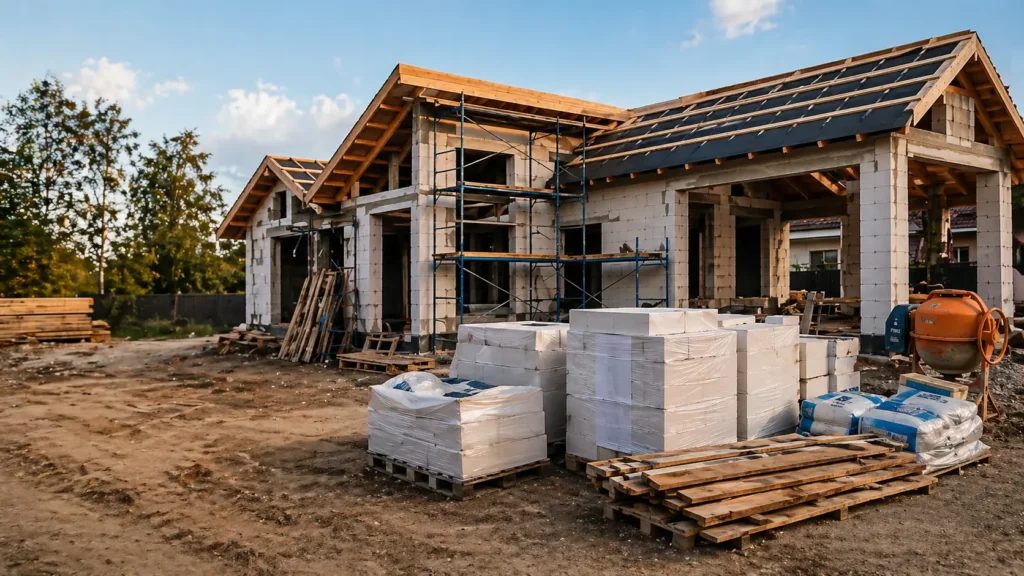
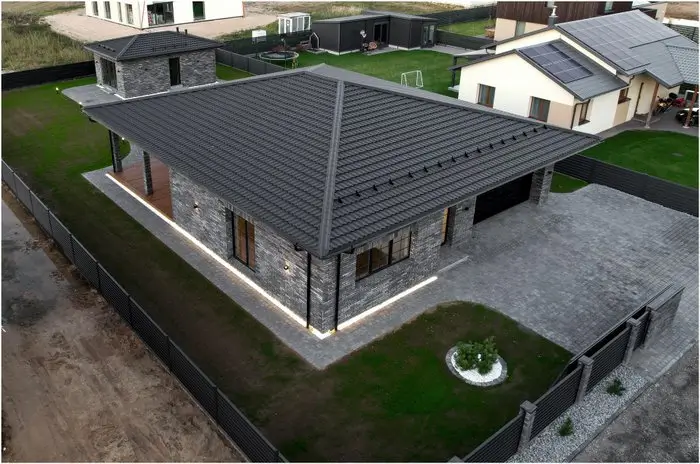
Foundation installation in Vilnius: pile foundations, strip foundations and CFA pile drilling
We install foundations for detached houses in Vilnius and Vilnius district: pile foundations, bored pile foundations, strip foundations, CFA piles, ground beams, thermo ground beams, foundation insulation, waterproofing and drainage. We work not just as a foundation crew — we can continue with walls, roofing, façades and the entire house construction through a single contractor.
Find out the cost of installing your foundations
Leave your phone number — we will contact you and discuss your project in Vilnius or the Vilnius region.
Have a design or foundation plan? Attach it along with a brief description of the work. We will prepare an estimate based on the design.
Don't have the design to hand? You can send an enquiry without it.
Call +370 640 28114The enquiry form is loading. If you cannot see it, call +370 640 28114.
Only the phone number is required. You can complete the other fields and provide documents if you have them. We will use the information provided to contact you about your enquiry.
Foundations are more than just pouring concrete
Foundation installation is one of the most important stages of house construction. Foundations determine not only the building's stability but also subsequent work: wall masonry, floor slabs, roofing, façades, ground-bearing floors, utility connections, thermal bridge management and the final cost of building the house.
Clients often want to save money and hire only foundation specialists, expecting another company to take over the entire house construction later. Problems arise when, after the foundations have been installed, inaccurate levels, misaligned axes, incorrect geometry, poor insulation detailing or a base unprepared for subsequent work become apparent. Responsibility then becomes unclear: the foundation crew says everything is fine, while the contractor who needs to build the walls and roof sees mistakes.
We therefore recommend considering foundation work as part of the whole construction process. The best solution is when the same contractor can install the foundations and continue with masonry, roofing, façades and complete house construction. This makes responsibility clearer, reduces rework and makes quality easier to ensure.
What types of foundations do we install?
The foundation type is selected based on the design, soil investigation, house structure, loads, site conditions and subsequent construction stages. There is no single best foundation type for every house — the solution must be selected for the specific project.
Pile / bored pile foundations
Pile foundations are often chosen for detached houses when loads need to be transferred to deeper, stronger soil layers. Typically, pile holes are drilled, reinforcement is inserted, concrete is poured and a ground beam is formed.
CFA piles
CFA pile drilling is a bored pile technology in which piles are drilled using a continuous flight auger, and concrete is supplied directly into the formed hole as the drilling equipment is withdrawn. This is useful for more challenging soils and efficient work.
Strip foundations
Strip foundations are suitable when the design and soil conditions allow continuous support to be installed beneath the walls. We carry out excavation, formwork, reinforcement, concreting, waterproofing and insulation.
Ground beam / thermo ground beam
A ground beam connects the piles into a single structural system. We can install an insulated ground beam using polystyrene specifically designed for foundations, so that additional insulation is not needed later.
Foundation insulation
For A+ and A++ energy-class houses, it is important to connect foundation, wall and floor insulation details correctly. This reduces the risk of thermal bridges and provides better preparation for subsequent construction.
Drainage around foundations
Drainage is required when site conditions, water levels or the design call for it. Drainage, waterproofing and backfilling solutions should be planned together with foundation work.
What is CFA pile drilling?
CFA piles are one of the key topics in foundation installation searches, as people often search for “CFA pile cost”, “CFA pile drilling cost”, “CFA pile drilling” or “CFA pile installation”.
CFA piles are bored piles installed using special CFA technology. CFA stands for “Continuous Flight Auger”, which can be explained simply as a drilling method using a continuous spiral auger. During drilling, the auger is lowered into the ground, and as it is subsequently raised, concrete is supplied directly into the formed borehole. A reinforcement cage is then inserted into the fresh concrete.
Simply put, CFA pile drilling allows piles to be installed quickly, neatly and with technical control. This method is most often relevant when the soil is more challenging, when water-bearing layers are present, when deeper piles are needed or when the design specifies higher loads. It is not the only way to install piles, but in certain cases it is a very practical solution.
How do CFA piles differ from conventional bored piles?
Not all pile foundations are CFA, but CFA piles belong to the bored pile category. Conventional bored piles for detached houses are often installed using smaller machinery, such as a tractor or compact drilling equipment. This solution can be economical for smaller houses when the soil is not challenging, the number of piles is limited and site access is convenient.
CFA pile drilling is more often chosen when greater productivity, deeper piles or work in more challenging soil is required, or when the aim is to reduce risks associated with loose and water-bearing soils. It is a more technically demanding solution, so the cost depends not only on the rate per metre but also on equipment mobilisation, pile diameter, depth, reinforcement, concrete volume and site conditions.
When is it worth choosing CFA piles?
CFA piles may be a suitable choice when the detached house being designed has higher loads, when the site has water-bearing or unstable soil, when greater pile depth is required or when work speed is important on site. However, the solution must always be assessed against the design, structural plans and soil investigation. Sometimes conventional bored piles are entirely sufficient for a smaller detached house, while in other cases CFA technology is the more practical choice.
The question should therefore not be simply “how much do CFA piles cost”. The right question is: which foundation solution best suits the specific house, site and subsequent construction process?
How are foundations installed?
The foundation installation process depends on the chosen type, but a responsible process always starts not with concrete, but with the design, soil, axes and precise preparation.
Assessment of the design and foundation plan
We review the foundation plan, house structural design, specified details, foundation type, ground beam, insulation, drainage and scope of work.
Assessment of site and soil conditions
Access, terrain, water risks, soil conditions and the need for additional solutions such as drainage are assessed.
Setting out axes and preparation
Accurate setting out is essential because the walls, floor slabs, roof and the entire subsequent house construction process depend on the foundation geometry.
Installation of piles, strip foundations or formwork
Pile drilling, CFA pile drilling, strip foundation excavation, formwork installation or ground beam formation is carried out according to the design.
Reinforcement, concreting and checks
Reinforcement is installed, concrete is poured, and levels, geometry and readiness for subsequent work are checked.
Insulation, waterproofing and drainage
The required insulation, waterproofing and drainage solutions are installed to prepare the foundations for subsequent house construction.
Foundation installation cost in Vilnius
The cost of foundation installation depends on the foundation type, soil, house area, structural design, reinforcement, concrete volume, pile depth, ground beam, insulation, waterproofing, drainage and overall scope of work. The exact price is therefore calculated based on the design rather than a single universal rate.
Indicative foundation work rates may start from 11 €/m², and strip foundation work may be priced from 51 €/linear m, but the cost of pile foundations, bored piles and CFA piles depends on pile diameter, depth, quantity, soil conditions, equipment mobilisation, and concrete and reinforcement quantities.
If you are comparing several offers, the most important thing is to check not only the total amount but also exactly what it includes: drilling, concreting, reinforcement, ground beams, insulation, waterproofing, drainage, backfilling, preparation for walls and the warranty.
View 2026 construction pricesWhy choose a full-service contractor rather than just foundation specialists?
Foundation errors often become apparent not on the day the concrete is poured, but when masonry, floor slab, roofing or flooring work begins. If foundation levels, corners, axes or details are inaccurate, corrections have to be made later, during more expensive stages.
When one contractor is responsible for foundations, walls, roofing and other work, responsibility is clearer. There is no need to argue about whether an error occurred during the foundation stage or later. All solutions are planned as a single system, rather than as separate tasks without a common approach.
NamStatyba.lt can carry out foundation installation, masonry, roofing, façade work, interior finishing and complete house construction in Vilnius and Vilnius district. This is particularly useful for clients who want clear responsibility, a single contract and fewer construction disputes.
House construction in VilniusWhat should you know before ordering foundation installation?
Pile foundations
Pile foundations are often used in detached house construction when loads need to be transferred to deeper soil layers. They can be installed in different ways: conventional drilling, CFA technology or other equipment, depending on the design and site conditions. Pile foundations are often combined with a ground beam that connects the piles into a single structural system.
Bored pile foundations
Bored pile foundations are one of the most commonly used solutions for detached houses. Holes are drilled, reinforcement is installed and concrete is poured. These foundations can be installed using smaller machinery, such as a tractor, when conditions are simpler, or heavier equipment when greater depths, diameters or productivity are required.
CFA pile cost
The cost of CFA piles depends on the number of piles, diameter, depth, concrete volume, reinforcement, equipment mobilisation, access and soil. General rates often shown on websites therefore do not always apply to a specific house. CFA may be a practical solution for one project but too expensive or unnecessary for another.
Strip foundations
Strip foundations are relevant when the structural design and soil allow continuous support to be installed beneath the walls. Strip foundation installation includes excavation, base preparation, formwork, reinforcement, concreting, waterproofing and insulation. This solution is often chosen for masonry houses, extensions, garages or other buildings.
Thermo ground beams and foundation-grade polystyrene
A thermo ground beam, or insulated ground beam, is relevant when the aim is to install the structural part of the foundations and address the insulation detail in a single stage. Using polystyrene specifically designed for foundations makes ground beam insulation more straightforward and eliminates the need to find additional solutions later for insulating a conventionally cast foundation.
Drainage around foundations
Installing drainage around foundations is not always necessary, but when water accumulates on the site, the groundwater level is higher or the design requires it, drainage becomes an important part of the foundation system. Foundation waterproofing, drainage and correct backfilling help protect the structure from the long-term effects of moisture.
What should a foundation estimate include?
A foundation estimate should clearly state whether it includes ground preparation, pile drilling, reinforcement, concrete, formwork installation, ground beams, insulation, waterproofing, drainage, backfilling, equipment delivery and preparation for subsequent work. If the estimate does not clearly specify what is included, the cheapest offer may later become the most expensive.
Is it worth having foundations built separately?
Foundations can be commissioned as a separate job, but this must be handled responsibly. If another company will continue the work after the foundations, levels, axes, geometry, details and responsibility must be agreed very precisely. In many cases, it is safer for a single contractor to coordinate the foundations and subsequent construction stages.
Frequently asked questions about foundations
What are CFA piles?
CFA piles are bored piles installed using continuous flight auger drilling technology. During drilling, soil is removed by the spiral auger, and as the equipment is raised, concrete is supplied directly into the formed hole.
How do CFA piles differ from conventional bored piles?
Conventional bored piles are often installed using smaller machinery, such as a tractor. CFA technology is more often chosen for more challenging soils, greater depths, more productive work and a more precise process.
How much does CFA pile drilling cost?
The cost of CFA pile drilling depends on pile diameter, depth, quantity, reinforcement, concrete volume, soil conditions, equipment mobilisation and site access.
How much does foundation installation cost in Vilnius?
The cost of foundation installation in Vilnius depends on the foundation type, soil, design, concrete, reinforcement, insulation, drainage and overall scope of work. An exact estimate is prepared based on the design.
Do you install strip foundations?
Yes, we install strip foundations: excavation, formwork, reinforcement, concreting, waterproofing, insulation and other related work.
Do you install insulated ground beams?
Yes, we can install insulated ground beams and thermo ground beam solutions using foundation-grade polystyrene or other insulation solutions specified in the design.
Is it worth choosing one contractor for foundations and house construction?
Yes, because responsibility is clearer, the risk of errors is lower and the entire process is smoother, from foundations to walls, roofing, façades and interior work.
Send us the design or foundation plan
We will prepare a foundation installation estimate within 48 hours. We will assess whether pile foundations, bored pile foundations, CFA piles, strip foundations, an insulated ground beam or another solution is more suitable for your project.