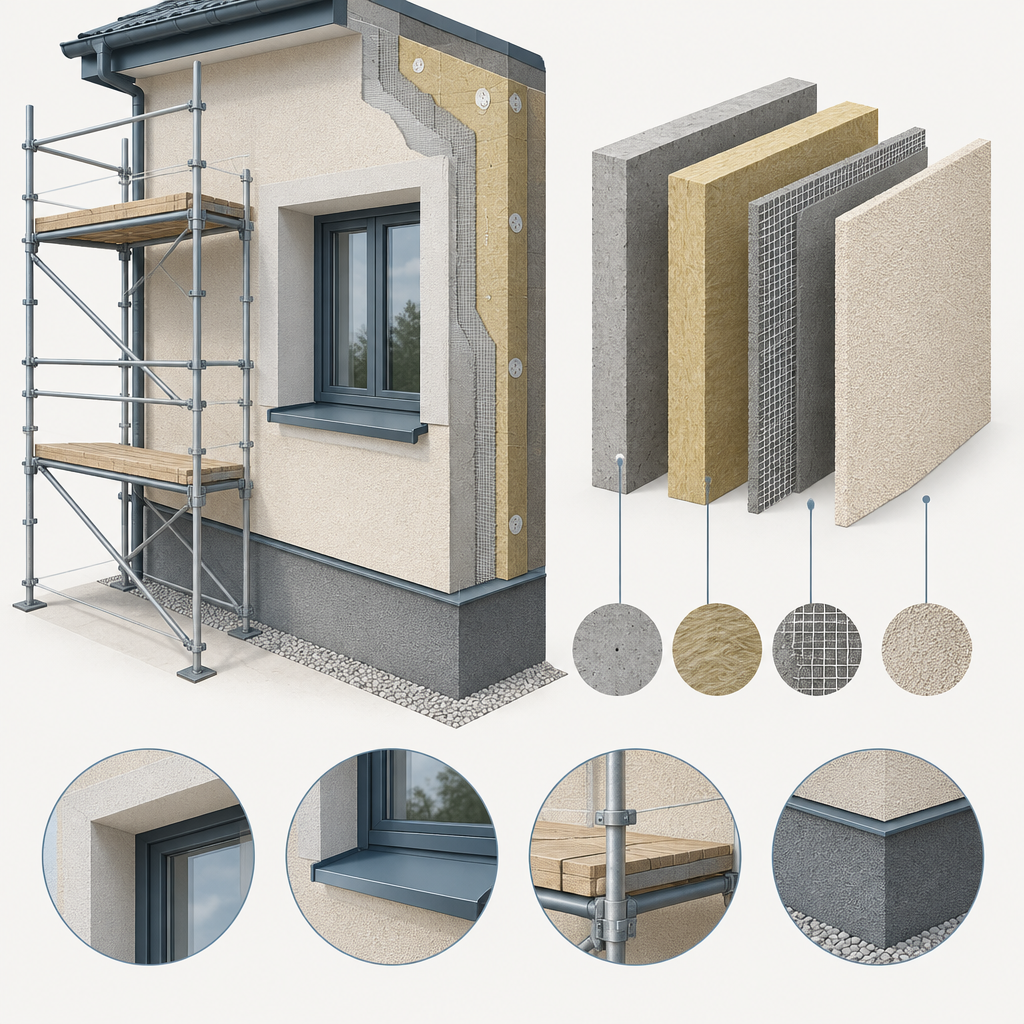
Have you received several quotes for facade work, but one lists a price per square metre, another gives a total, and the third lists materials separately? The lowest figure does not yet show which quote offers the best value. First, you need to establish whether all contractors have allowed for the same scope of work and the same final result.
Facade work costs can only be compared once quantities, material specifications, included stages and terms for additional costs have been aligned. The checklist below will help you distinguish a clear quote from one whose final total is still unknown.
First, agree on the result you are comparing
Give all contractors the same information: facade drawings or dimensions, photos of the current condition, the planned insulation and finish solution, and the scope boundaries. If a solution has not yet been chosen, assess alternatives separately. Different facade systems should not be compared solely by their installation rates.
Ask for the quote to list the stages: substrate preparation, insulation, fixing, reinforcement, priming and finishing—as required for the specific project. The entry “facade work” does not tell you whether the entire process or only part of it is included.
Check the area calculation method
- Is the wall area calculated by deducting window and door openings?
- Are reveals included in the wall area or priced separately?
- What units are used to measure corners, window sills, profiles and junctions?
- Is the plinth listed as a separate item?
The same rate per m² does not necessarily mean the same total. Ask for the quantity, unit of measurement and an explanation of what is included in each item. This will help you avoid both omitted work and counting the same item twice.
Scaffolding: more than just hire
It is worth breaking down the scaffolding item. Check whether the quote covers delivery, erection, use for the agreed period, dismantling and removal. Separately, clarify whether the required protection for the work area and facade has been allowed for.
The key question is— who pays for extended scaffolding use and under what circumstances. Ask for the method of calculating extensions if the work takes longer due to weather, additional substrate repairs or a change in scope. It is better to discuss responsibility for different causes of delay before work begins.
Also provide information about access, narrow passageways, terraces, canopies or other elements that may make scaffolding erection more difficult. If site conditions have not yet been assessed, these costs should not be considered final.
Which facade junction details should you check in the estimate?
Junction details are the connections and terminations between different facade elements. Their scope is not always clearly reflected in the wall area, so it is worth keeping a separate list.
- Windows and doors: reveals, sealing of junctions, finishing at the frames.
- Window sills: removal of existing sills, supply of new ones or reinstatement of existing ones, installation and junctions.
- Plinth: substrate condition, planned layers, finish and junction with the main facade.
- Corners and roof junctions: profiles, terminations, junctions at the eaves or other structures.
- Existing elements: removal and reinstatement of downpipes, light fixtures, cables and other parts attached to the facade.
For each relevant item, specify who supplies the materials and who carries out the work. If the solution is unknown, mark it “to be clarified” rather than leaving a blank line that could later be assumed to be included in the total price.
Materials and finishes: check the specific specification
Phrases such as “quality materials” or “decorative render” are not enough. Ask for product names, planned thicknesses, quantities and technical documents. It must also be clear which facade system and its requirements were used to select the components used together.
For the finish, the product type, texture, grain size, colour and planned work stages matter. If the colour or texture has not yet been agreed, clarify whether the final choice could change the price. Material substitutions should only be allowed once their impact on the solution and estimate has been agreed in writing.
Assess the substrate and required waiting periods
The quote must distinguish which substrate preparation work has already been allowed for and how defects discovered later will be agreed upon. Also check whether the work schedule includes the waiting periods required for the specific materials and protection from weather exposure.
For example, the manufacturer’s information for “Ceresit CT 74” specifies conditions for substrate preparation, temperature, humidity and protection of the drying layer. These apply to that specific product, not to all facade finishes. Therefore, a single universal drying period should not be applied to all quotes.
Checklist for three quotes
Copy the table and fill in the column for each quote. Use the statuses: “included”, “priced separately”, “not included”, “unclear” or “not applicable”. Alongside them, enter the quantity, unit and amount where provided.
| Item to check | Quote A | Quote B | Quote C |
|---|---|---|---|
| Work stages and final result | — | — | — |
| Area, deduction of openings and measurement method | — | — | — |
| Scaffolding, period of use and extension | — | — | — |
| Substrate preparation and defect assessment | — | — | — |
| Material products, thicknesses and quantities | — | — | — |
| Reveals, window sills, plinth and junctions | — | — | — |
| Finishing product, texture and colour | — | — | — |
| Transport, protection and waste removal | — | — | — |
| Removal and reinstatement of existing elements | — | — | — |
| VAT, validity and procedure for additional work | — | — | — |
| Recording of stages and acceptance of work | — | — | — |
Comparable total = quote total + known additional costs required for the same agreed scope. Compare all amounts on the same VAT basis. Keep optional additions separate.
If an essential item has not yet been priced, mark the quote “not yet comparable”. An unknown price is not a zero price. This checklist helps compare the content of quotes, but does not in itself prove the quality of a contractor’s work.
When do you need a designer rather than just a quote?
Consult a designer when solutions are missing or changes are planned: a different facade system is selected, the insulation solution is changed, or window, plinth or roof junctions are unclear. A specialist assessment is also needed if you notice cracks, moisture damage, a detached substrate or have doubts about fixing options.
An estimate item does not replace a technical solution. Do not select layer thicknesses, fixings or junctions solely on the basis of the cheapest quote. Depending on the site’s circumstances, a structural engineer or another specialist in the relevant field may be needed.
What should you provide for an individual cost assessment?
- The site location, facade drawings or available dimensions.
- General photos of the facade and problem areas.
- The project or available material and finish specifications.
- A list of the desired work and what has already been completed.
- Information about access, scaffolding space and the preferred timing of the work.
“Namų Statyba” provides services in Vilnius and Vilnius district. When planning facade finishing work, the cost needs to be assessed based on the project and scope of work. The more clearly the items are defined, the easier it is to compare quotes and discuss possible changes in advance.
Research sources
- Plasterers in Vilnius – Interior wall plastering – Fasador.lt
- Flexible Clinker | Elabrick / Elastolith facade finishes in Vilnius
- Facade insulation and finishing cost | Royal Decors
- CERESIT CT 74 SILICONE SELF CLEAN SELF-CLEANING SILICONE MESH, PEBBLE TEXTURE – CERESIT
- Facade finishes in Vilnius – insulation and work prices
Prepared using AI and research of public sources. General information does not replace an individual project and a specialist assessment.