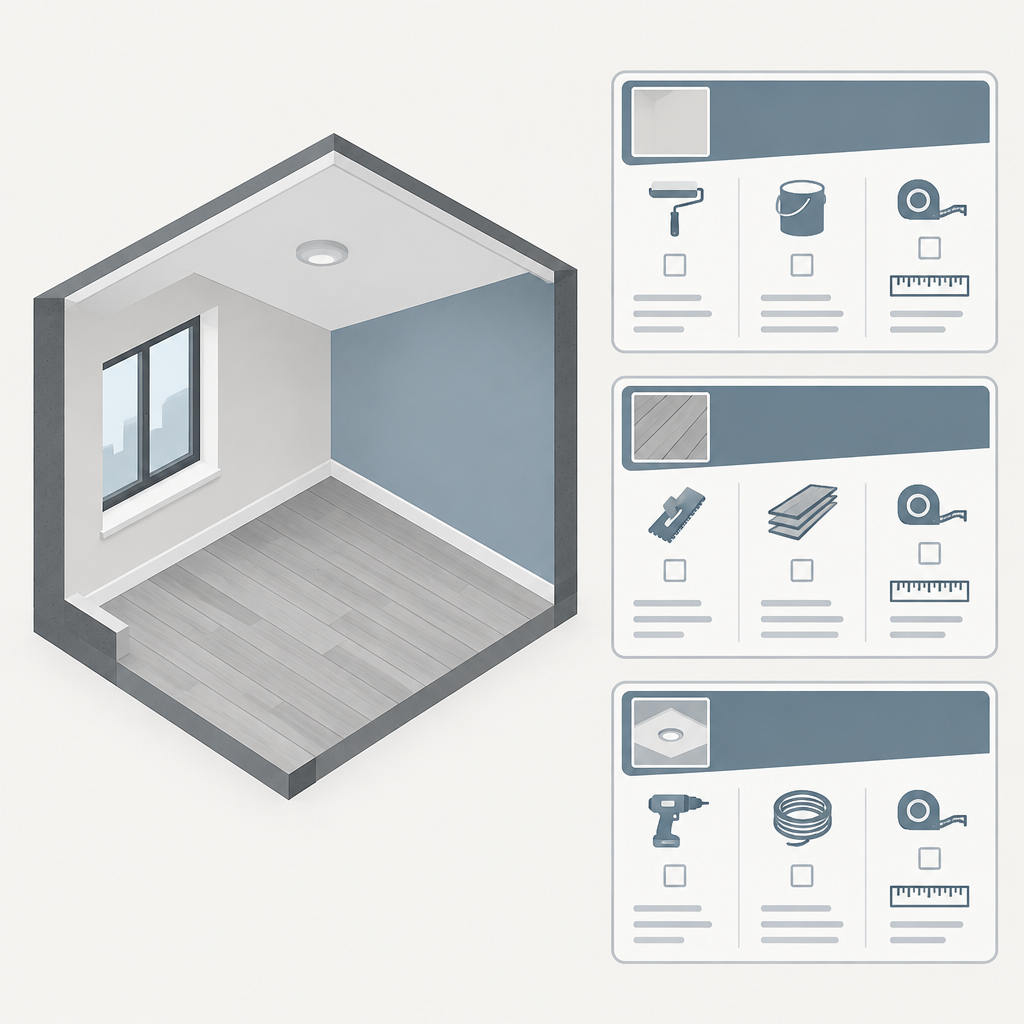
One contractor provides a total price for interior finishing, another quotes rates per square metre, and a third calculates materials separately. Which quote is better? Until the scope of work and the cost breakdown match, the final totals alone do not provide an answer.
First standardize the brief, quantities and included costs, then compare prices. The table and review process below will help you distinguish a genuine price difference from a simply incomplete estimate.
Interior finishing costs 2026: what are you actually comparing?
This article is not a price list. A specific price must be assessed based on the project and scope of work: the current condition of the premises, the chosen finishes, preparation, materials and work arrangements.
Even identically named line items can mean different work. In one quote, “wall painting” may include only applying paint; in another, it may also include surface preparation, priming and protecting the premises. So ask not just for the names of the tasks, but also for a clear description of what they include.
1. Give all contractors the same brief
Prepare a single brief document and mark its date or version. Attach a plan, photos of the current condition and any available finishing specifications. If the specifications have not yet been chosen, state what the contractor should assess provisionally and what should be left for clarification.
- List the rooms and the work required in each.
- Separate removal of existing finishes, substrate repairs and installation of new finishes.
- Specify the intended surfaces and final result.
- Indicate who buys the materials and arranges their delivery.
- Describe the conditions for site access, carrying materials in, storage and waste removal.
- Ask for assumptions and excluded work to be listed separately.
If you add information to the brief for one contractor, pass the same information to the others. Otherwise, you will be comparing different versions of the brief.
2. Agree on quantities and measurement rules
A home’s floor area is not the quantity of wall or ceiling finishing work. Each line of the estimate must clearly state which surface is being measured and which unit is used to calculate the work: m², metres, units, hours or an agreed stage.
Before comparing quotes, agree on how window and door openings, reveals, niches and small surfaces are accounted for. Ask whether the quantities provided have already been checked on site or calculated only from the plan.
The preparation description must also be specific. Instead of “prepare for painting”, list the required operations and the agreed final result. The number of coats alone does not describe the full scope; the work method must suit the substrate and comply with the documentation for the selected materials.
3. Complete a shared comparison table
You can transfer this template to a spreadsheet. Repeat the work rows for each room and finishing stage. Replace the dashes with quote details or a clear status.
| Comparison field | Shared brief | Contractor A | Contractor B | Contractor C |
|---|---|---|---|---|
| Work and room | Exact list of tasks | — | — | — |
| Quantity and measurement | Unit, quantity, treatment of openings | — | — | — |
| Preparation | Operations and agreed result | — | — | — |
| Cost of work | Separate amount or defined package | — | — | — |
| Materials | Who buys them, what is included, which specifications apply | — | — | — |
| Logistics and cleanup | Delivery, carrying materials in, protection, waste | — | — | — |
| Amount payable | Clear VAT treatment and cost breakdown | — | — | — |
| Excluded items | Required additional work or costs | — | — | — |
| Unspecified items | Missing quantity, scope or price | — | — | — |
| Schedule and payments | Stages, dates, payment terms | — | — | — |
| Quote version | Date and validity period | — | — | — |
Four statuses instead of ambiguous empty cells
- Included: the scope is clear, and the price is stated or the work is explicitly identified as part of the package.
- Excluded: a required item is not included in the quote.
- Unspecified: confirmation of the price, quantity or scope is missing.
- Not applicable: your project does not require this item.
An unspecified price is not zero. An empty cell does not mean that the contractor will perform the work at no additional charge, either.
4. How do you compare a package with separate rates?
Suppose both quotes cover preparation and painting of the same walls. The example below illustrates differences in scope, not actual rates.
| Item | Quote A: package | Quote B: separate tasks |
|---|---|---|
| Substrate repairs | Included, scope described | Unspecified |
| Filling and priming | Included in the package | Separately priced line items |
| Painting | Included in the package | Separately priced line item |
| Materials | Included, specification provided | Purchased by the client, cost not assessed |
| Comparison conclusion | Can be checked against the shared brief | Not yet comparable: repair and material costs are missing |
Quote B does not become cheaper simply because the stated total is lower. First, the substrate repairs need to be clarified and the cost of materials purchased by the client assessed using the same specification.
Comparable total = quoted total + confirmed costs of missing items − confirmed reduction for omitted unnecessary work.
Apply a reduction only after the contractor has confirmed that a specific task can be omitted and how much this changes the price. Do not subtract parts of a package at your own discretion. Also, do not add a second charge for work or materials that are already included.
If significant costs remain unclear, mark the total as “not yet comparable”. Keep the budget contingency separate: it does not replace pricing the missing items.
5. Manage additional work and estimate versions
Previously unseen defects may become apparent when surfaces are exposed. Before any additional work, record the following in writing:
- What was found and why a change is needed.
- What work is proposed, its quantity and materials.
- How much the amount payable changes and whether VAT has been accounted for.
- How the work schedule changes.
- Who approved the change and when.
Include the approved change in a new version of the estimate. Keep the previous version, but make decisions based on the latest agreed document.
When is comparing estimates alone not enough?
A comparison table does not confirm the suitability of technical solutions and does not, by itself, prove the quality of the work. A higher price is not automatic proof of a better result.
Consult a designer or a specialist in the relevant field when planning structural changes, creating openings, changing the layout or significantly altering electrical, plumbing or ventilation solutions. It is worth clarifying wet-room installation details if the waterproofing, slopes or drainage solutions are unclear. The cause of cracks and moisture should not be addressed simply by choosing a finishing material.
The design documentation or approvals required depend on the building and the planned work. Resolve technical uncertainties before requesting a final quote.
Checklist before choosing a contractor
- All contractors assessed the same version of the brief.
- Quantities, measurement rules and the scope of preparation have been agreed.
- Material specifications and responsibility for purchasing them are clear.
- Logistics, protection and waste costs are identified.
- The amount payable and VAT treatment are clearly stated.
- Excluded and unspecified items are not disguised as zeros.
- Schedules, payment stages and approval of changes have been discussed in writing.
- The date and version of the selected quote have been saved.
When planning interior finishing in Vilnius and Vilnius district, you can discuss your specific project and scope of work with “Namų Statyba”. The price should be assessed based on these details, and quotes compared using the same clearly described brief.
Research sources
Prepared using AI and research of public sources. General information does not replace an individual project and a specialist’s assessment.