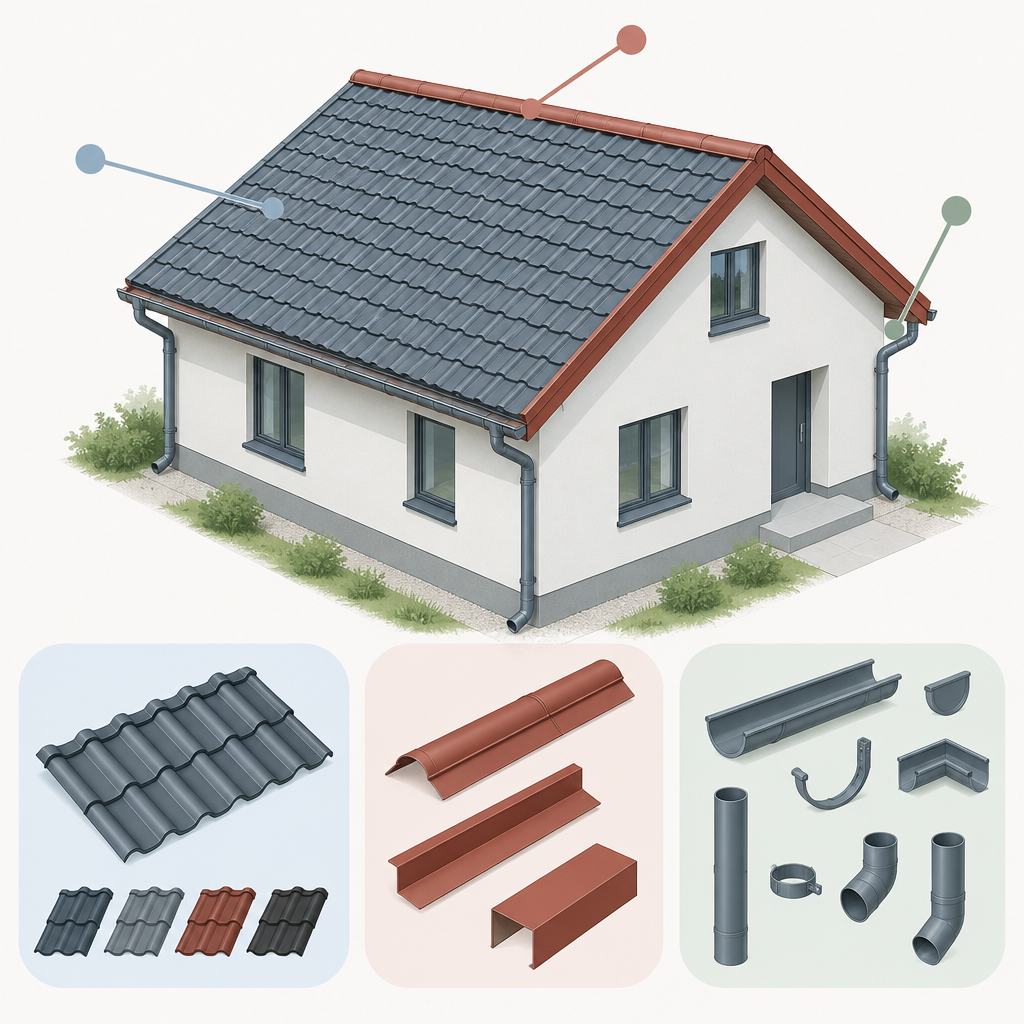
Roofing costs including materials can only be meaningfully compared when quotes cover the same result. One quote may include the roof covering and its installation, while another also includes flashing, gutters and downpipes. In that case, a lower total does not necessarily mean a lower price for the same scope of work.
This guide will help you check three interconnected parts of an estimate: the roof covering, flashing and rainwater drainage system. The aim is to understand what you are buying, what information is missing and when roofing alternatives must first be assessed by a designer.
What does a price “including materials” actually mean?
This wording must be accompanied by a clear list of materials and work. On its own, it does not tell you whether membranes, battens, fasteners, sealing materials, roof edge components and the rainwater system are included.
First, ask for the quote to be divided into three sections. Each should state the material specification, quantity, unit of measurement and installation scope.
- Roof covering: the specific product, quantity of roofing, required underlying layers and fasteners.
- Flashing: components for the ridge, eaves, roof edges, valleys and junctions with other building elements.
- Rainwater system: gutters, downpipes, brackets, connectors, corners, outlets, bends and the planned water discharge.
Transport, lifting or access work and other costs required for the specific site must be shown separately. Also check whether the stated amount includes or excludes VAT, where VAT applies.
Comparing roof coverings: more than just the material price per square metre
Actual roof area and the quantity of roofing purchased
The floor area of a house is not its roof area. And the actual roof area to be covered does not necessarily match the area of material purchased: overlaps, cutting and offcuts required by the specific geometry may increase the quantity.
Ask for the area to be covered and the quantity of roofing to be ordered to be stated separately. If the quote is given in euros per square metre, clarify which area the rate applies to. Manufacturers’ technical data may distinguish between a product’s overall and effective width; an example of this distinction is provided in the “Ruukki Classic LowCarbon” product data. The parameters of a specific product cannot be applied to all roof coverings.
Compare specific products and their installation
Descriptions such as “metal roofing” or “roof tiles” are not enough. You need the manufacturer, model and specification. Different coverings may require different substrates, fasteners, additional components or installation work.
- Is the selected product suitable for the existing roof pitch?
- What is its weight, and is the structure suitable for the expected loads?
- What substrate and ventilation solutions are planned?
- Do the roofing alternatives include all the layers and accessories they require?
A cheaper roof covering does not necessarily mean a lower total installation cost. A comparison requires the complete set of materials and work for each specific alternative, not just the main roofing line item.
Flashing estimate: what should be itemised?
A single “flashing” line item does not let you check which roof details are included. Ask for a list of only the components relevant to your roof and their quantities.
- Ridge: planned components, length and associated sealing or ventilation elements.
- Eaves and roof edges: sheet metal components and their installation.
- Valleys: components for internal junctions between roof slopes, if such junctions exist.
- Chimneys and wall junctions: flashing and sealing of the specific junctions.
- Other openings: junction components for roof windows or penetrations according to the selected system.
The sheet metal specification, fasteners and sealing materials also matter. The same component length does not mean the same set of components is included. The manufacturer’s installation instructions library helps explain why different roof details are assessed separately, but does not replace the solutions specified for an individual project.
Rainwater system: lengths alone are not enough
Gutter and downpipe lengths are only part of the system. The quote should specify the manufacturer or system, its size, downpipe locations and required accessories. System selection must be based on the rainwater collection conditions of the specific roof, not just the lowest package price.
Check brackets, connectors, end caps, corners, outlets, bends and downpipe fixings. The range of sizes and components can be seen in the manufacturer’s description of rainwater drainage systems, but the appropriate size is selected for the specific roof.
Clearly agree where the scope of work ends. Installing a downpipe does not necessarily include drainage across the property, underground pipes or connection to an existing system.
A practical comparison of two quotes
Suppose quote A describes the roof covering and its installation in detail, but lists flashing as a single amount and excludes the rainwater system. Quote B lists all three sections, but it is unclear whether the roofing quantity refers to the purchased area or the area to be covered. Neither quote is ready for a final comparison yet.
You can copy this table and ask both quote providers to complete it.
| Section to check | What must be clarified | Quote A | Quote B |
|---|---|---|---|
| Area | Area to be covered and quantity of roofing purchased | Enter | Enter |
| Roof covering | Manufacturer, model, specification, accessories and installation | Enter | Enter |
| Substrate | Planned layers, materials and their installation | Enter | Enter |
| Flashing | Individual details, quantities, materials and installation | Enter | Enter |
| Rainwater system | Size, lengths, accessories and the endpoint of water discharge work | Enter | Enter |
| Other costs | Transport, access, lifting and other planned work | Enter | Enter |
| Total amount | Applicable taxes and items not yet priced | Enter | Enter |
Mark each line as: included, excluded or to be clarified. “To be clarified” does not mean zero euros. Prices for excluded items must be obtained separately, rather than assumed to match the rates in the other quote.
Once the scope is aligned, the total amount can be divided by the same actual roof area. The resulting figure is suitable for comparing these specific quotes, but is not a universal price for another roof.
When is a designer’s assessment required?
An estimate table does not confirm structural safety or the suitability of a roof covering. Consult a designer if the covering’s weight, roof geometry or structure is changing, or if new openings or additional loads are planned. An assessment is also needed when the condition of the structure or the suitability of the selected covering for the roof pitch is unclear.
If deformation, damaged timber or signs of moisture are visible, simply calculating the quantity of roofing is not enough. The required solutions must be determined first; only then can the cost of implementing them be reliably compared.
What should you provide for a cost assessment?
Prepare any available project documentation, roof plan or dimensions, pitch information, photos, preferred roofing alternatives and a clear list of work. Mark chimneys, roof windows, junctions and planned downpipe locations. Identify missing information rather than replacing it with guesses.
“Namų Statyba” provides services in Vilnius and Vilnius district. If you are planning roofing work in Vilnius and Vilnius district, submit the information you have and the intended scope of work. The price must be assessed according to the specific project and scope of work, and quotes should only be chosen after clarifying differences in what they include.
Research sources
- Roofing cost 2026 — guide | MB Sky House
- Roofing prices 2026: calculator and pricing guide | Stogas virš galvos
- How much does a roof cost in 2026? Price per m², materials and labour
- Roofing cost in Vilnius: what affects it | MEBA
- Classic LowCarbon (LIMITED EDITION!)
- Installation instructions
- Rainwater drainage systems | Downpipes | Gutters
- Roofing in Vilnius – prices and roof replacement
Prepared using AI and research from public sources. General information does not replace an individual project and a specialist’s assessment.